
Something weird happens when you give people three options instead of two.
In a classic 1992 study, Itamar Simonson and Amos Tversky asked people to choose between two cameras. 50% went for camera 1, and 50% chose camera 2.
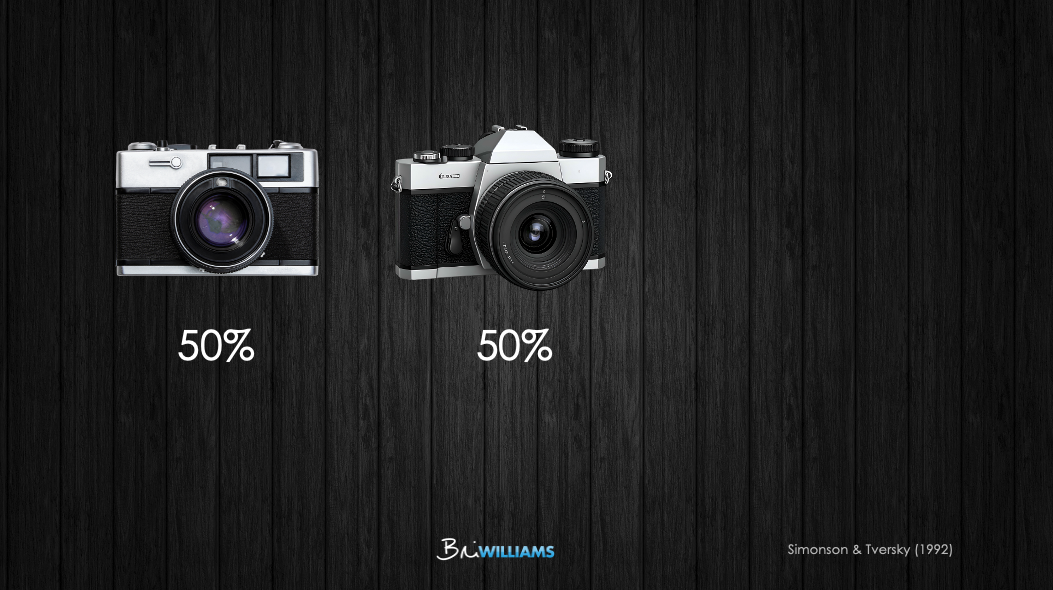
When a third, more expensive option was added, the ratios changed dramatically.
Now, only 22% chose camera 1 – the cheapest.
21% chose camera 3, the most expensive, and 57% opted for camera 2, in the middle.
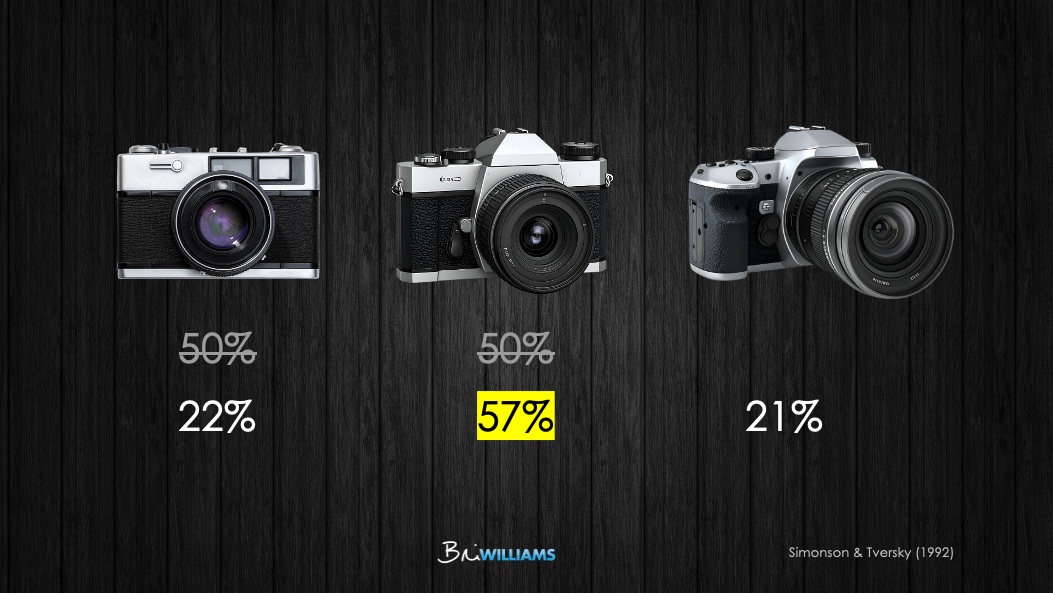
Even though the pricing of cameras 1 and 2 hadn’t changed, people’s preference for them did.
This is the compromise effect (also known as the “Goldilocks effect”).
When a third option is included, the middle one becomes the “just right” choice between two extremes.
It’s easier to justify and feels like the safest option.
Does that mean you should always have three options?
Not necessarily.
If you offer one option, it becomes a yes or no decision.
Two options become a “which is better?” decision.
Three options mean you will probably warp the distribution of choices in favour of the middle. Whichever you include in the middle should therefore have the best margin and be the one you are happiest to sell.

Ref: Simonson, I., & Tversky, A. (1992). Choice in context: Tradeoff contrast and extremeness aversion. Journal of Marketing Research, 29(3), 281–295. https://doi.org/10.2307/3172740
🌟 If you found this interesting, let me know! Buy me a virtual coffee ☕ or forward this email ↗️ to someone who also might like it. Your support means I can keep sharing ideas about behavioural science for free.
💪 Find out where your team can do better (influencing diagnostic)
📈 Take your team to the next level of influence (team development)
🧠 Learn the science of Influencing Action (online course)
Hey, are we connected yet?


