
Part 8. Using a Mullet Meetings approach to improve meetings.
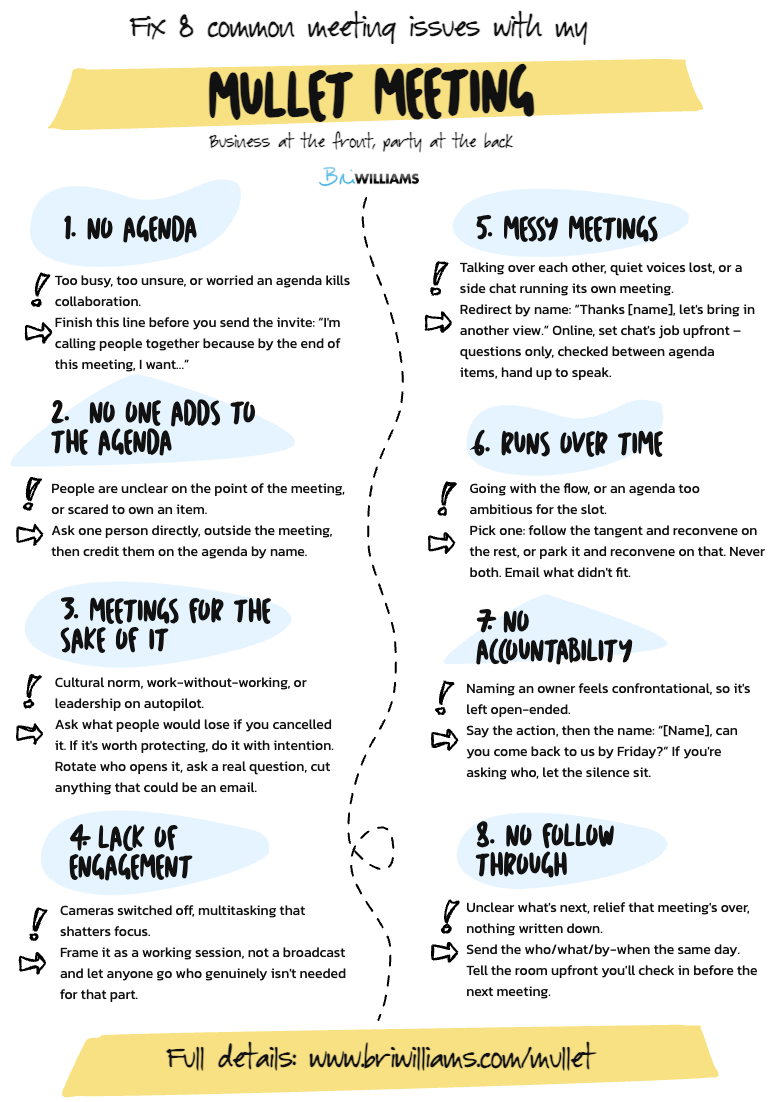
Welcome to our final Mullet Meeting instalment. So far we’ve covered seven sins when it comes to meetings:
I said there would be eight issues, and it’s important to follow through. Which brings us to our final topic. Follow through.
Issue 8: No follow up/follow through
The meeting went well, but there’s no follow through. Why?
Ambiguity
People aren’t clear who needs to do what. Follow your meeting with a brief email capturing what was agreed. It really needs to happen the same day as the meeting.
If you struggle to find time for this type of admin, cut your meeting by 5 minutes and use that time to send it out.
Job done
You’re so relieved you’ve clarified what needs to happen that you assume it will. But the meeting isn’t the outcome. It’s part of the process to get to the outcome.
For that reason, it’s helpful to close your meeting with next steps so you and everyone else recognises there’s more to be done.
Nothing documented
Don’t rely on people noting down their own actions. While you should be able to trust adults to follow through, you need to capture and disseminate three things: who is doing what by when.
Don’t want to nag
It can feel awkward to follow people up, but that’s what you should do. Set an expectation in the meeting by saying you’ll be checking in on their progress before the next meeting. Approach this as someone seeking to support them so they welcome your contact.
That concludes my Mullet Meetings mini-series. I hope it has unpacked why meetings go awry and what you can do about it.
To make that easier, I’ve prepared a PDF which you can download here.
Has the Mullet Meeting approach helped with your meetings? Let me know.

P.S. Save the Mullet webpage for a summary of the eight issues we've covered.
🌟 If you found this interesting, let me know! Buy me a virtual coffee ☕ or forward this email ↗️ to someone who also might like it. Your support means I can keep sharing ideas about behavioural science for free.
💪 Find out where your team can do better (influencing diagnostic)
📈 Take your team to the next level of influence (team development)
🧠 Learn the science of Influencing Action (online course)
Hey, are we connected yet?


