
There’s a faster way to board a plane.
All the airlines know about it, but none use it.
Why?
It’s called the Steffen Method.
Working from the back to the front, window seats are boarded first. Then middle. Then aisle.
By reducing congestion, simulations have shown boarding time can be halved.
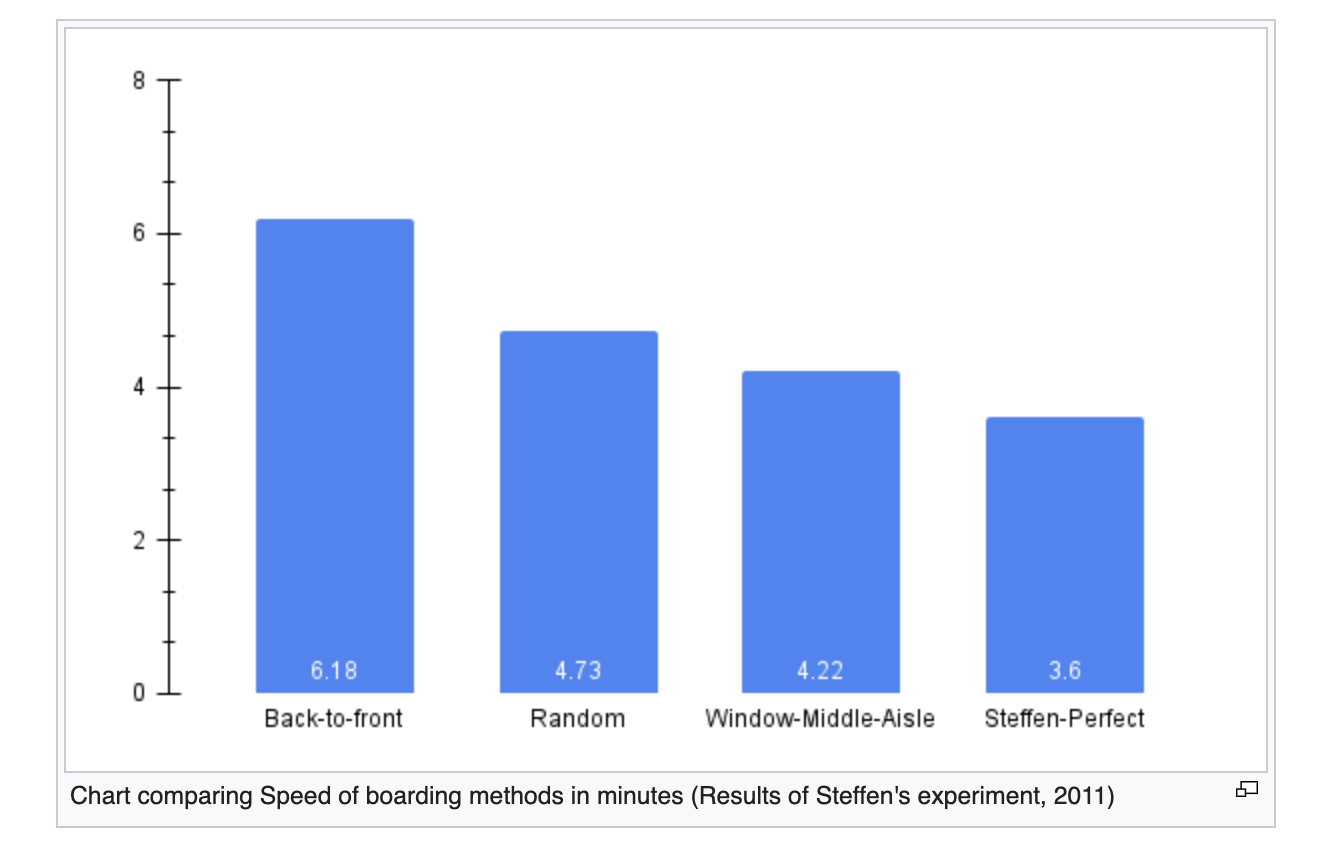
That’s millions of dollars potentially saved.
So why doesn’t anyone use it?
Because it would be a disaster.
Airlines know something many workplaces still forget: People are messy, emotional beings.
- They want to board with their family.
- They worry there won’t be enough overhead luggage space.
- They care about fairness and status.
So airlines optimise for efficacy over efficiency.
Yet in many workplaces, we still pretend customers and colleagues are rational, compliant automatons.
We design business processes and change programs that assume information drives action, that policies will be read and followed and that money is the only motivation.
But just like boarding a plane, real behaviour is messy, emotional, social and complex.
That isn’t a flaw in the system.
It is the system.
And that's the system we need to design for.

Ref: Steffen, Jason (2008). "Optimal boarding method for airline passengers". Journal of Air Transport Management.
Ref for chart: https://en.wikipedia.org/wiki/Steffen_Boarding_Method
🌟 If you found this interesting, let me know! Buy me a virtual coffee ☕ or forward this email ↗️ to someone who also might like it. Your support means I can keep sharing ideas about behavioural science for free.
💪 Find out where your team can do better (influencing diagnostic)
📈 Take your team to the next level of influence (team development)
🧠 Learn the science of Influencing Action (online course)
Hey, are we connected yet?


