
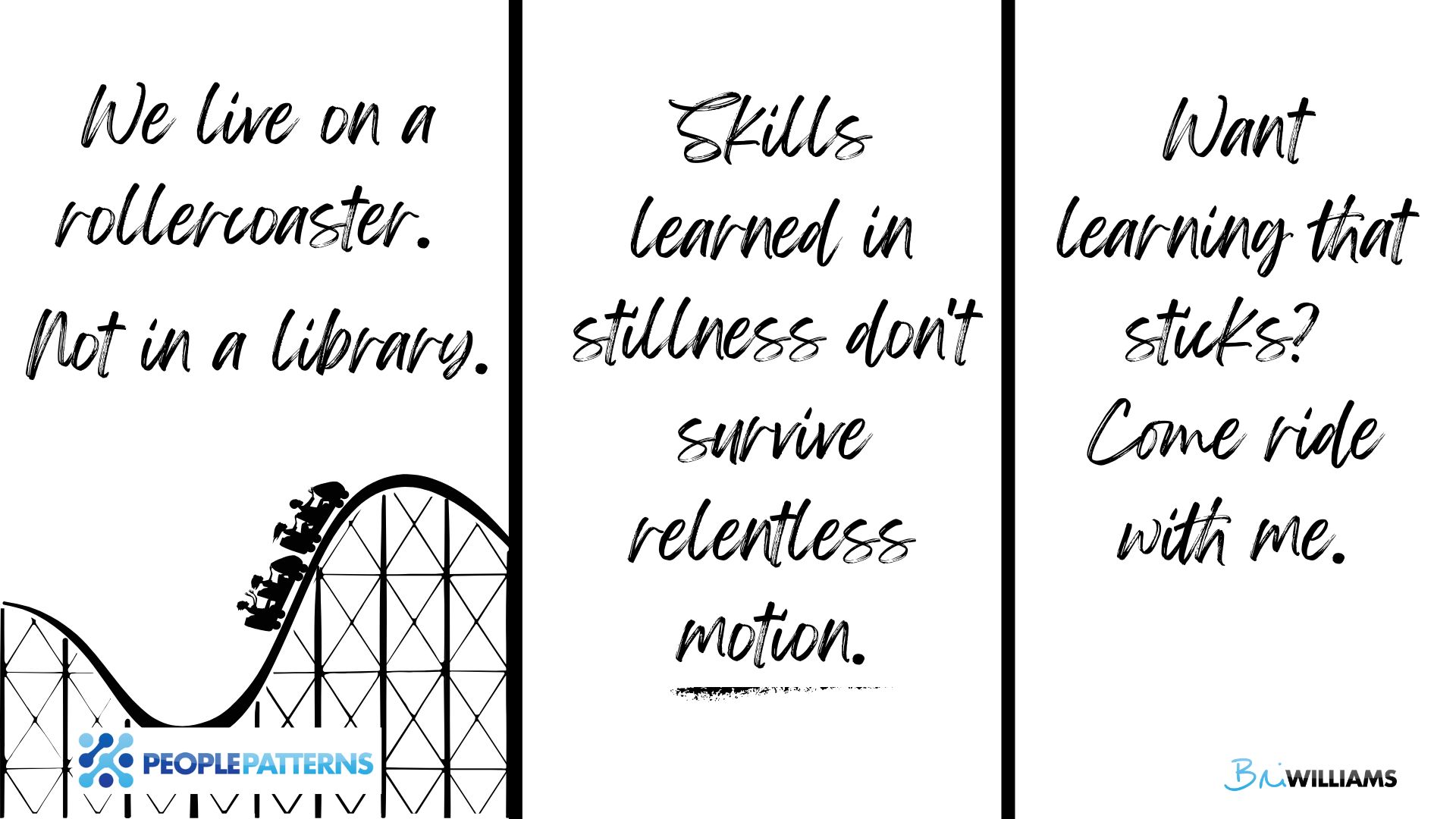
We live on rollercoasters, not in libraries.
So when you send someone on a course and three weeks later nothing has changed, that's probably why.
For years I designed and delivered workshops that people genuinely enjoyed.
But back in the workplace, old habits crept back in.
I told myself the problem was on their end – competing priorities, unsupportive managers, not enough time.
Eventually I had to admit the problem was my approach.
They were learning in a library.
Quiet, structured, distraction-free environments where new ideas made perfect sense.
What I wasn't doing was preparing people for the moment they walked back into chaos.
Because life isn't a library. It's a rollercoaster.
It’s fast, changeable, and unforgiving.
Skills learned in stillness don't translate to relentless motion.
So I changed how I transfer skills (I've noted 3 changes below).
The goal isn't a great day in the room. It's a different life outside it.
If you manage a team and you've ever wondered why training doesn't seem to translate, it's probably not your people.
It's likely the gap between how they learned and where they're expected to perform.
Life is a ride, not a library.

You can see a visual overview of my training program here.
What did I change?
3 things:
1. We build genuine appetite for change – not just interest, but the kind of motivation that survives a bad Tuesday.
2. We practice skills based on real work. Not just understanding a new approach but using it when things are messy, pressured, and imperfect.
3. This is where most training falls short – we work on making new behaviours habitual. That means applying them to real challenges participants are facing right now, not hypothetical case studies. It means follow-up coaching. It means recap sessions that replenish their toolkit.
🌟 If you found this interesting, let me know! Buy me a virtual coffee ☕ or forward this email ↗️ to someone who also might like it. Your support means I can keep sharing ideas about behavioural science for free.
💪 Find out where your team can do better (influencing diagnostic)
📈 Take your team to the next level of influence (team development)
🧠 Learn the science of Influencing Action (online course)
Hey, are we connected yet?


