
It’s one of the most embarrassing business meetings of my consulting career.
I was invited by a former colleague to come and speak about behavioural economics with their head of Customer Insights.
It was around 2012, and I’d launched my practice the previous year. Books like Nudge and Predictably Irrational were topping best seller lists, so there was plenty of buzz in the market.
After listening to me talk about what I was doing, he paused and asked a simple question: Why do I need this?
At the time, and to my shame, I didn’t have a good answer.
Because to him, when it came to understanding customer behaviour, he had his bases covered.
A full program of qualitative and quantitative research. Focus groups, online panels. Net Promoter Scores. Website analytics. Retention and attrition rates.
Why did he need behavioural economics?
This is why.
There are four ways to understand customer behaviour. At best he was covering three.
The one he was missing was the one that would have given him the answer all businesses want: What will they do?
- If we put a campaign in market, will people switch?
- If we launch a new product, will they buy?
- If we change our pricing, will they churn?
Behavioural economics is different. Unlike market research, it's based on observed behaviour, not self-reported. Unlike data analytics, it's not just historical. It anticipates what people will do next.
That should have been my answer, and I’ve been giving it in nearly every pitch meeting since.
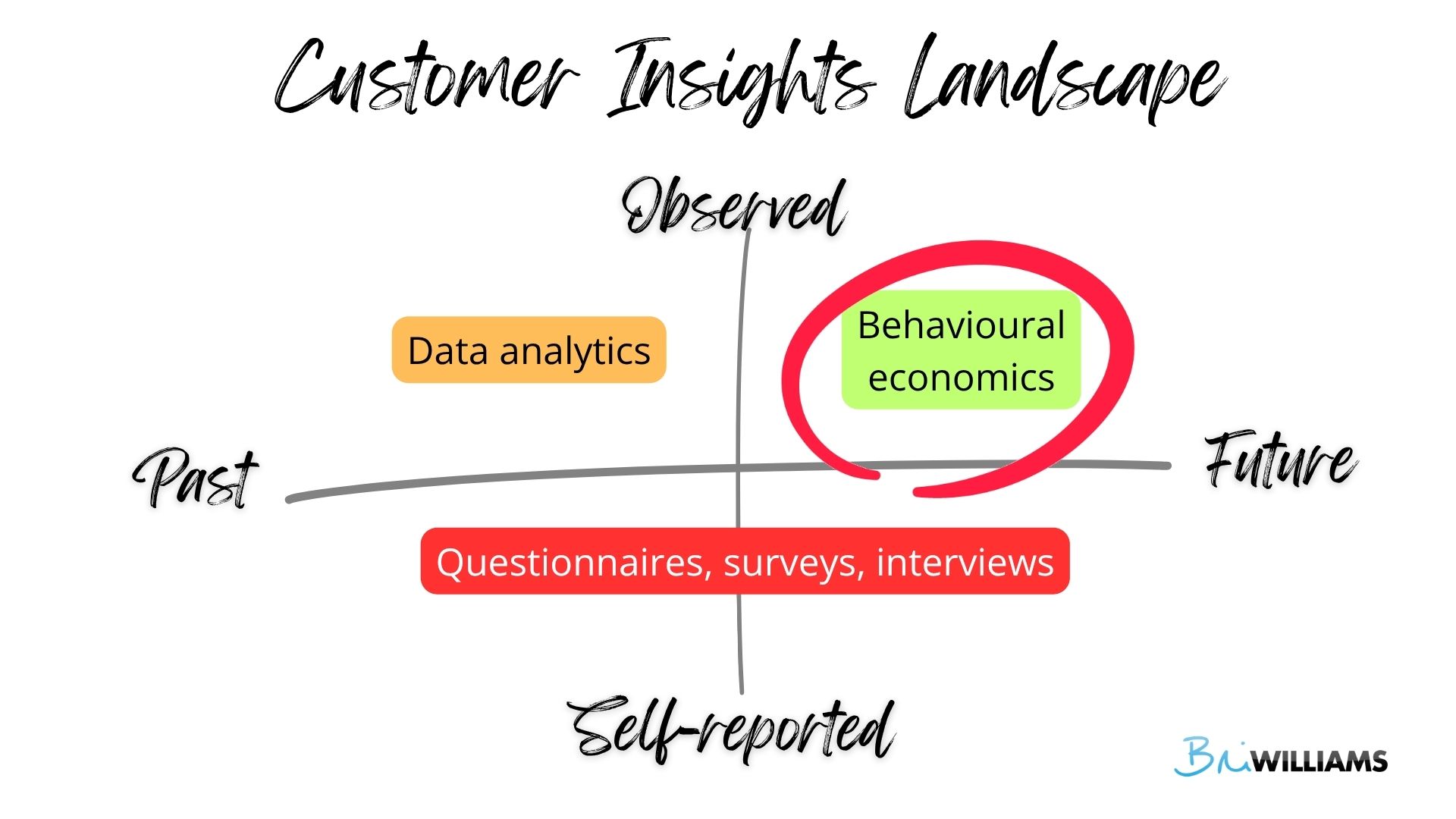
Here’s my quick explainer of the Customer Insights Landscape.

🌟 If you found this interesting, let me know! Buy me a virtual coffee ☕ or forward this email ↗️ to someone who also might like it. Your support means I can keep sharing ideas about behavioural science for free.
💪 Find out where your team can do better (influencing diagnostic)
📈 Take your team to the next level of influence (team development)
🧠 Learn the science of Influencing Action (online course)
Hey, are we connected yet?


