
Why sell bad products?
Because you don’t expect them to sell at all.
This is the Decoy Effect, and it has big implications for how you pitch ideas, not just products.
The Decoy Effect is a close cousin of the Compromise Effect, which I wrote about last week.
They can seem the same because they often include three options.
But there’s a key difference, which I’ll explain in a minute.
Because first, let’s talk beans.
A study in a UK supermarket tracked sales of two brands of baked beans across two weeks.
In the first week, the cheaper brand got 19% of sales. The market leading brand dominated with 81%.
In the second week, they did something strange. They added a third tin to the mix.
This was a smaller tin of the cheaper brand, at the same price as its big tin.
People would pay the same but get less. Not great.
Did anyone actually buy the smaller tins? No.
But when they compared it with the larger version, the larger tin seemed like great value.
The cheaper brand’s share jumped from 19% to 33%, and the market leader dropped to 67%.
Where the Compromise Effect is about position – adding a premium option so the middle one feels like the safe choice – the Decoy Effect is about comparison.
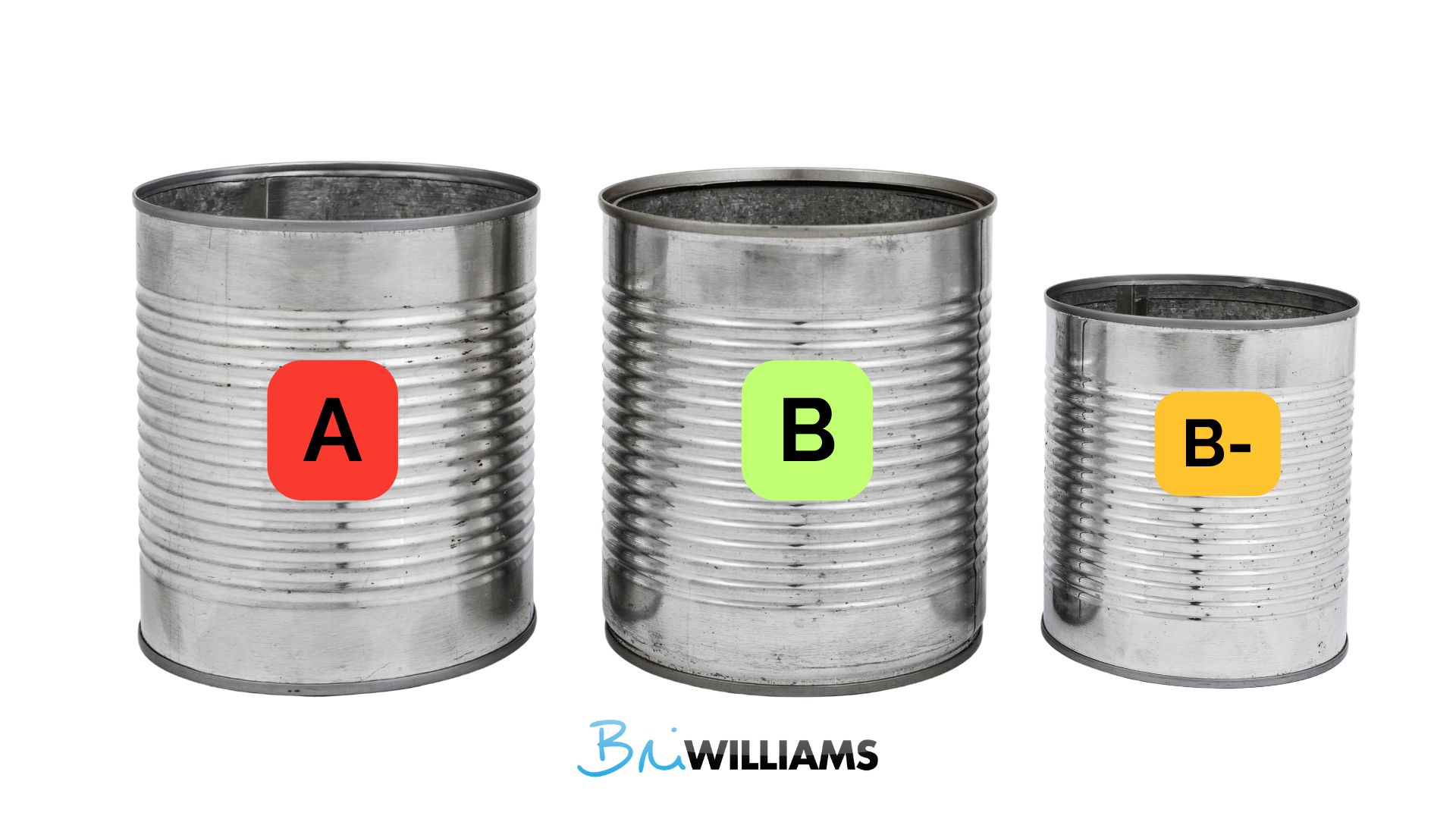
When people are stuck between two options – say A and B – adding a third, like B minus, which is almost the same but slightly worse than B, makes people more attracted to B.
This doesn’t only apply to retail. It can work for project and strategy decisions too.
Say your stakeholders are deadlocked.
Option A is patching the current system for $150k.
Option B is a full system upgrade, done in six months for $400k. Half the room wants A, half wants B.
Now add B minus: the same upgrade, for the same $400k, but it takes nine months rather than six.
Nobody will pick it. But next to it, B suddenly looks fast and efficient, and A doesn’t get a comparison it can win.
If you’re going to use the Decoy Effect, it works best on people who haven’t made up their minds: new customers, one-off purchases, and the fence-sitters.
A 2025 study of 3.6 million real wine purchases found the decoy effect was small, and barely showed up for regular buyers i.e. People with entrenched views are much harder to shift.
Make your decoy close to the option you want, just a little worse.
And make sure it's a real option. If stakeholders spot a straw man, you’ll lose more credibility than you gain.

Refs:
Doyle, J. R., O’Connor, D. J., Reynolds, G. M., & Bottomley, P. A. (1999). The robustness of the asymmetrically dominated effect: Buying frames, phantom alternatives, and in-store purchases. Psychology & Marketing, 16(3), 225–243. https://doi.org/10.1002/(SICI)1520-6793(199905)16:3<225::AID-MAR3>3.0.CO;2-X
Devine, S., Goulding, J., Harvey, J., Skatova, A., & Otto, A. R. (2025). How decoy options ferment choice biases in real-world consumer decision-making. npj Science of Learning, 10, 60. https://doi.org/10.1038/s41539-025-00341-2
🌟 If you found this interesting, let me know! Buy me a virtual coffee ☕ or forward this email ↗️ to someone who also might like it. Your support means I can keep sharing ideas about behavioural science for free.
💪 Find out where your team can do better (influencing diagnostic)
📈 Take your team to the next level of influence (team development)
🧠 Learn the science of Influencing Action (online course)
Hey, are we connected yet?


